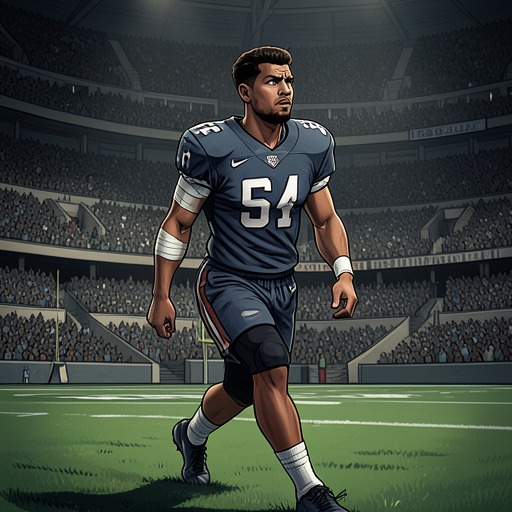
James Jorkins
The Journey CollectionJames Jorkins, known within the Miami Sharks as JJ, is the head coach who drafted Travis McCoy and helped establish the professional life that Travis later leaves behind. His importance lies less in the number of scenes he occupies than in what he represents at the moment of departure: the coach who recognized Travis’s value, the institution that made him, and the football world that cannot follow him into the family life he has chosen.
Identity and Professional Role
James Jorkins is the head coach of the Miami Sharks. The team knows him simply as JJ, a demanding authority whose glare is powerful enough to make players feel as though he could turn them to stone. He has thinning, sandy-brown hair, gray-blue eyes, and a deep Southern drawl associated with his Louisiana background. His manner is blunt and intimidating, but the severity is balanced by long familiarity with the players and a clear investment in their development.
Jorkins’s connection to Travis is especially foundational. He was the coach who drafted Travis, giving him an opportunity when he was a young player just out of college. Travis later describes that opportunity as a kind of home offered at a moment when he needed one. The relationship therefore joins professional judgment to personal gratitude: Jorkins did not merely supervise Travis’s career; he helped create the setting in which that career became possible.
The Sharks and Travis’s Departure
Jorkins’s authority becomes significant after Travis’s shoulder injury ends his playing career. The injury places Travis on the reserve list, and Stewart Thornton, the Sharks’ owner, offers him a coaching position as special teams coach in succession to Jerry Morton. Travis declines the offer after returning to Texas and discovering that Penelope and Max, rather than football, must define his future.
The public version of this decision is repeatedly mediated by news reports. Tamara Roberts reports that Travis is leaving the Sharks after turning down the special-teams position, while Malcolm Rollins is presented as the player ready to lead the team. The coverage reduces a complicated decision involving injury, family, and identity to a sports-business story. Jorkins’s private response supplies a more intimate counterpoint. He is not chiefly concerned with the headline or with the injury’s publicity; he is concerned that the team has lost someone difficult to replace and that Travis has rejected a role Jorkins believed he could fill.
When Jorkins appears in the locker-room doorway, the Sharks players have already been sent onto the field. Travis knows that the coach drafted him and that they had always gotten along, yet he is uneasy because leaving the game has altered the terms of their relationship. Jorkins admits that he had always known this day would come, but he also calls Travis foolish for turning down the offer. His irritation expresses the football world’s practical logic: if Travis cannot play, coaching seems to offer the obvious way to remain attached to the sport.
Conflict, Respect, and Advice
Jorkins presses Travis about the vacancy and reminds him that Jerry Morton recommended him for the position. The exchange is sharp rather than sentimental. Travis apologizes, but Jorkins rejects apology as a solution to the team’s staffing problem. Beneath the complaint, however, lies a recognition that Travis has earned the offer because of his knowledge, authority, and relationship with the game.
Travis explains that football has been his life since childhood. He once dreamed of standing in the largest stadium in the world while crowds chanted his name, and he even slept with his football. He acknowledges that he had a successful career, with more victories than defeats, but says that he can no longer continue as a player. Returning home has changed the question. He has found a future in Texas with people who love him and need him, so he declines the Sharks’ offer respectfully.
Jorkins does not dismiss Travis’s continuing love for football. Instead, he distinguishes loving the game from remaining employed by it. He observes that many players care chiefly about money or magazine covers, whereas Travis never lost sight of what it felt like to play. That assessment gives Travis’s departure a moral dimension: the decision is not an escape from football because he has ceased to care, but a refusal to let football remain the highest claim on his life.
Jorkins’s most important request is that Travis teach Max how football feels. He asks Travis to show his son that the game is not about a paycheck, and not even ultimately about winning a championship. The advice extends Jorkins’s coaching beyond the locker room. Travis’s next responsibility is not to produce another professional athlete but to pass on an understanding of play, commitment, and meaning within a family relationship.
Farewell and Narrative Significance
Travis thanks Jorkins for giving him a chance when he was a young college graduate and for giving him a home when he needed one. Jorkins responds with equal warmth, calling it an honor to have been Travis’s coach. His joking warning that he will come to Texas and make Travis run if he mistreats his family keeps the farewell in the language of football while redirecting that language toward fatherhood. Travis answers with a promise, and Jorkins squeezes his hand before returning to the team.
After Jorkins leaves, Travis remains alone in the locker room and reflects on the room’s history. It has witnessed his highest moments and his lowest ones, including nights spent nursing an aching shoulder or sore elbow. He will miss the Sharks, the stadium, and his teammates, but the knowledge that Penelope and Max are waiting makes it possible for him to walk away with his head held high. Jorkins’s farewell thus becomes the emotional hinge between two kinds of belonging: the professional home that formed Travis and the family home he now chooses.
James Jorkins’s narrative role is consequently that of mentor, institutional representative, and witness to an identity transition. He embodies the football system’s legitimate claim on Travis without being reduced to an antagonist. His disappointment is real, yet his final response recognizes that Travis’s priorities have changed. Through Jorkins, the story frames retirement not as the disappearance of a football identity but as its reorientation: the former quarterback remains someone who loves the game, while becoming a partner to Penelope and a father to Max.